Versions stored in different places
Printed documents and shared folders make the current instruction difficult to find.
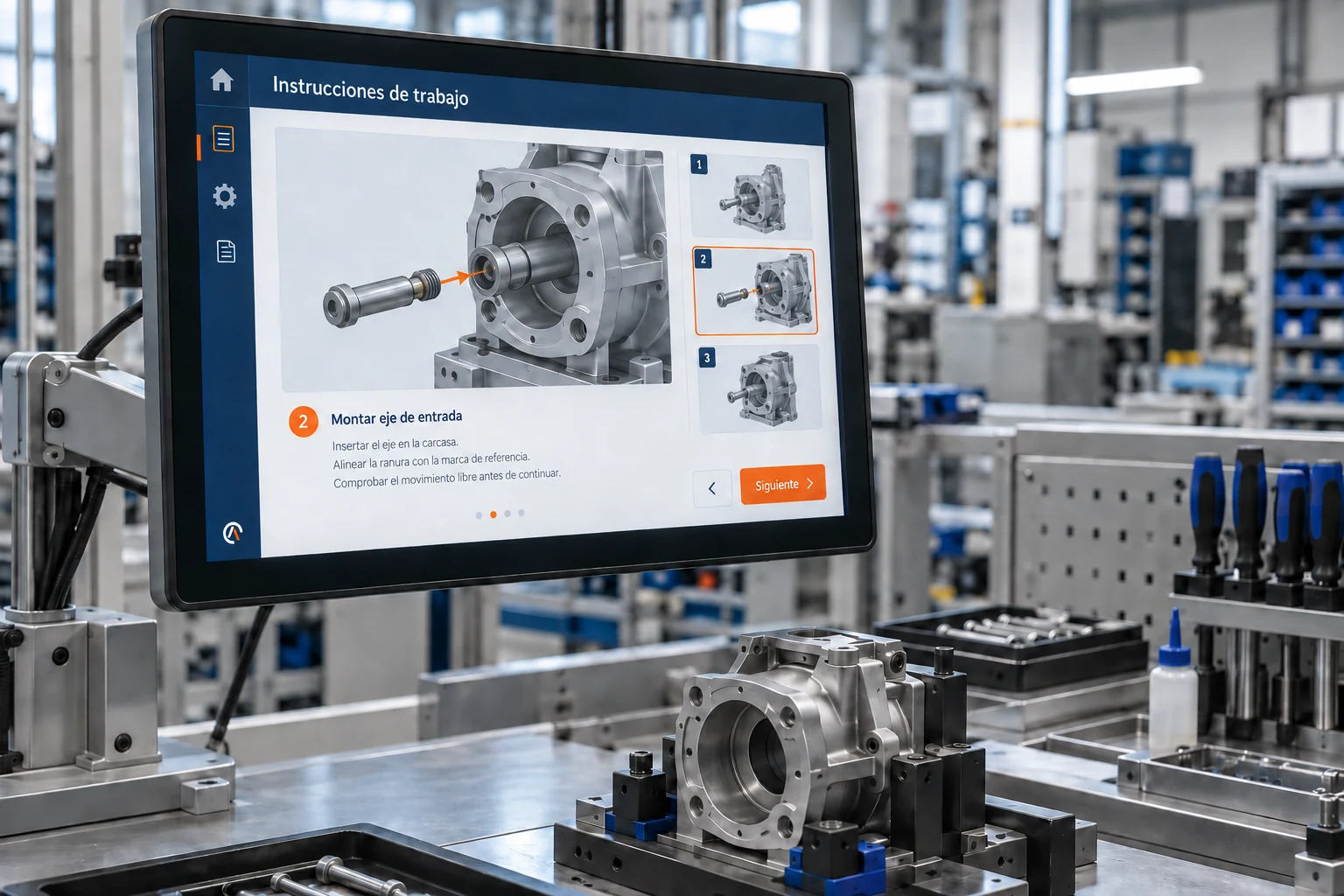
Bring work instructions to the operation to support execution and connect instructions to what is being manufactured.
Engineering and software connected to your operation.
Printed documents and shared folders make the current instruction difficult to find.
Operators need to check details without leaving the context of their work.
Instructions and operation records are consulted separately.
PAsk yourself this: how do you think it is easier to learn: through endless texts to memorize, or with an integrated interactive system of texts, images and videos showing the right content at the right time? The question answers itself, and that is why digital work instructions have revolutionized and simplified the way of training operators or employees in factories and companies.
Your workforce needs to acquire step-by-step training in a clear, concise and simple way. And if this form of training can be tailored to each employee, and they can refer to it anytime, anywhere, what are you waiting for to implement digital work instructions?
Let's start with this example: the manual for the Airbus 330 aircraft is 630 pages long. If you know what a 500-page package looks like, you can get an idea of how long the manual is. It takes pilots hundreds of hours to learn how to skillfully fly that aircraft. And if it weren't for flight simulators, they would never really learn it, because there's nothing like visualizing what you have to learn in your own contextual environment.
Any specific procedure can be learned in the best way through digital work instructions, because the learning methodology is based on human-centered resources and elements, such as audios, videos, images, infographics, etc.
If you have a thousand employees and you print a thousand manuals and at a given moment something needs to be modified, expanded or corrected, you will have thrown away the cost of those manuals. In the digital environment, you can change any content instantly.
While building interactive and interconnected digital content may take more time, the bottom line of time saved among your employees will be in your favor, because it will be available anywhere, anytime, without relying on heavy physical manuals.
When content is clear, displayed with a simple interface and focused on the employee, they are more open to learning, as they are used to handling digital content, such as their own social networks.
Digital work instructions set a standard for work procedures that are easy to consult at all times. That's why training is a form of reciprocal communication between you and your employees.
A guide consists of several topics, each topic consists of several instructions and each instruction consists of several steps or actions. Going from one step at a time, it is easier to create digital work instructions for employees.
In training sessions, interaction between employees is enhanced by sharing the content viewing experience. This increases motivation and the spirit of collaboration by creating a shared learning environment.
Clear instructions combine the task, the necessary information and the context of the operation. The presentation adapts to the workstation and the process.
Information linked to the order and workstation.
Work content presented clearly.
Review how each instruction is published and maintained.
Instructions and execution within the same workflow.
In a logistics and transport company, an infographic for sales reps with the sales argumentation of a rate depending on the weight of the shipments that the pre-customer handles.
QR codes attached to specific parts of a piece of machinery, linked to videos showing how to operate those parts, viewable at any time.
System of badges and rewards to guarantee the evolution of training for each employee.
Update specific content and send notifications to employees to ensure receipt of instructions.
We examine the profile of your employees. Do they need to learn a specific process or general instructions? Are they for everyone or for a small group? For sales people or for operators? Do they have a company cell phone, do they work from home?
We start from the existing guide to dissect what content can be implemented in a digital context. If no such guide exists, we create it with you.
We create the content and design the user experience to present it.
We implemented it in the testing phase through selected pilot trainings.
We monitor results and track learning.
Digital recipes or digital work/process instructions are a must to ensure that everything is done according to company norms and standards, and that's something that printed work/process instructions can't give you. check it out here!.
We review existing content and how to adapt it for consultation at the workstation. The scope depends on the formats and updating process.
Visual guidance and augmented reality are considered when they help the process. They are not a requirement for digitalising instructions.
We include training for shop-floor staff unless it is determined to be unnecessary. If you need additional training, we can arrange it around your team’s needs.
We offer a priority support and maintenance service when you need it. We agree the service model, scope and terms with you to suit your operation.
We currently work in Spain. We can also undertake projects in Portugal, other European Union countries and beyond, agreeing the scope and working arrangements with you.
Bring work instructions to the operation to support execution and connect instructions to what is being manufactured.
Tell us where you are starting. Together we will define the next step.