The batch is known, but the process is missing
You know the product reference, but not all the details of how it was manufactured.
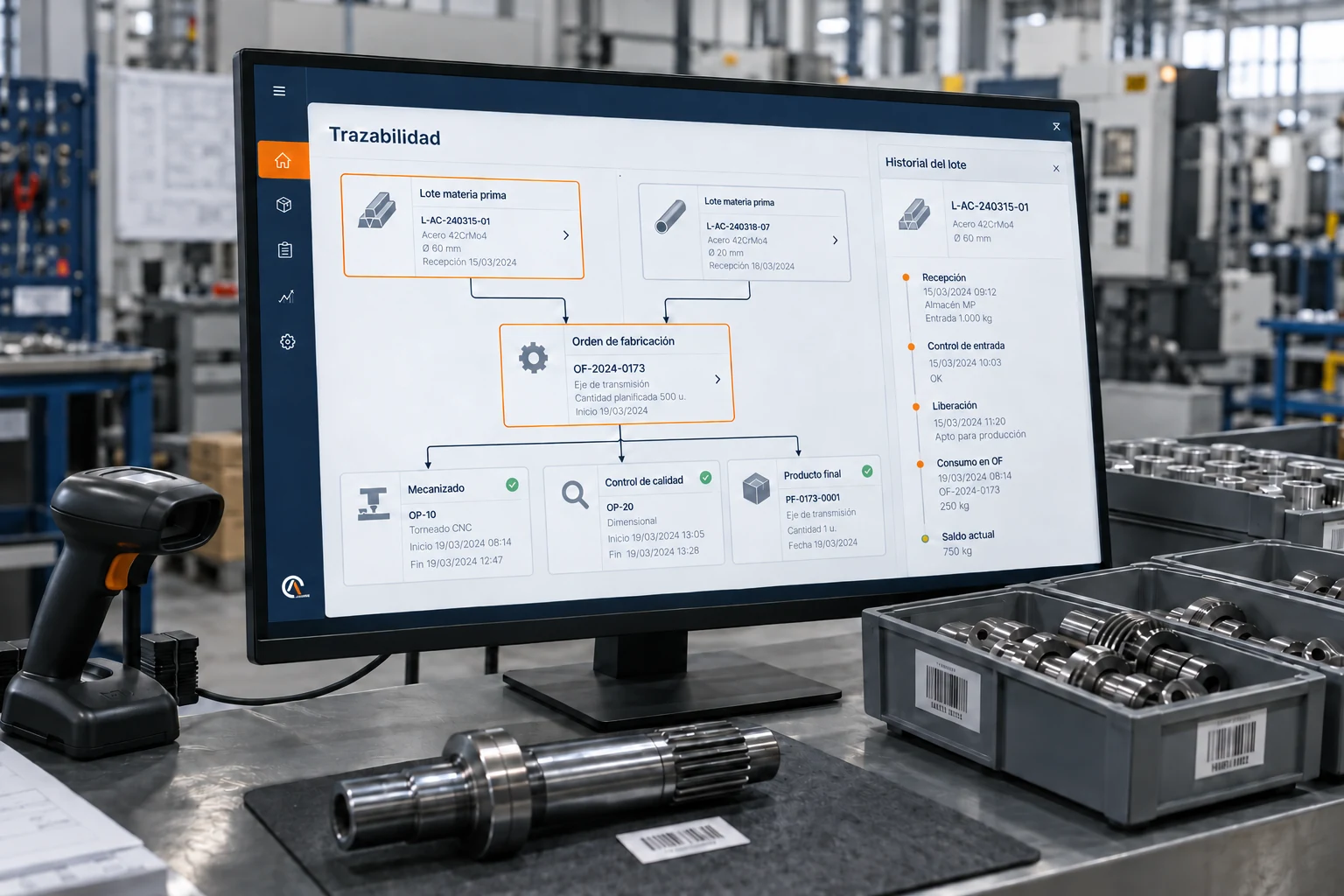
Link materials, operations and checks to reconstruct a product's journey without searching through separate files and records.
Engineering and software connected to your operation.
You know the product reference, but not all the details of how it was manufactured.
Each query involves combining spreadsheets, reports and records from different systems.
It is difficult to identify products that share materials or operations.
Since you took the control of your factory or company, you have had many ideas for new products and services. And they all have one thing in common: they have followed a series of processes from their origin to the final result. Tracking these processes in your production chain is known as traceability and product genealogy., and goes far beyond "getting from point A to point B".
Indeed, product traceability processes involve the application of quality standards (e.g. ISO norms, but there are many others), through a standardisation that minimises errors while saving time and cost. For example, you could build a rocket to go to the moon, but it might not be the best idea to do it in wood. When standard rules and industrial traceability software are applied, the methodology makes sense..
Process traceability is essential to identify errors in the flow of product or service creation.. Going back to the wooden rocket example, you can build all the parts perfectly out of wood, but on the first test launch of the rocket you will realise that wood was not the best material (have a good fire extinguisher at hand). You chose the wrong materials, even though the parts were perfect. In process traceability, there are two phases:
What materials will you need, in what proportion, and what are the logistical steps (the so-called "tiers") to obtain your final product before launching it on the market?
It involves logistical strategies and processes once the product or service has been launched on the market. Has packaging been broken? Has the cold chain been interrupted during transport? Do you have a plan to manage mishandling?
When a product does not meet the required quality, identifying the points in the creation process that can be improved or corrected is key.
It is obvious that if you do not have identified all the processes that are part of the creation of a product, it will take you longer to identify errors by having to review the whole process.
Nowadays, consumers want to know what they are buying. If you are transparent in the process of creating your products, your end customer will have more confidence in you.
From the moment materials enter your factory or company, they have followed standards for creation and transport. Standards validate the supply chain.
Connect the different areas of your factory vertically and horizontally, synchronising the details of work orders, quantities, times, and more.
It is not the same for your operators to work under uncertainty and improvisation as it is for them to work knowing that they are backed and assured by a quality standard.
Consult source materials, completed operations and associated checks. The journey should be traceable in both directions.
Linked materials, references and batches.
Operations and parameters associated with manufacturing.
Connections between inputs, transformations and outputs.
Records linked to the product for easy access.
In a microwave oven factory, control the stock of the parts that make up the microwave ovens, depending on the final outcome of the products.
Track shipments by controlling the exact location of the package at all times, through phase differentiation.
Improve your factory supply chain flow and quality control of your final products in real time.
Create a log of the daily actions of all operators and extract metrics for each performance to detect peaks and troughs in productivity.
We examine your factory or company to understand the process of creating your product or service.
We advise you on the necessary and missing standards, if any, to ensure the correct workflow.
We add extras to that workflow, such as barcodes or QR codes with internal data to track each step.
We obtain data in real time to facilitate fast reaction times for decision making.
We monitor results and follow up on the supply chain.
They are complementary perspectives: product traceability identifies what was manufactured and with which materials; process traceability provides the context of the operations performed.
We first study your needs and existing systems. The scope may focus on traceability or form part of a manufacturing management project.
We include training for shop-floor staff unless it is determined to be unnecessary. If you need additional training, we can arrange it around your team’s needs.
We offer a priority support and maintenance service when you need it. We agree the service model, scope and terms with you to suit your operation.
We currently work in Spain. We can also undertake projects in Portugal, other European Union countries and beyond, agreeing the scope and working arrangements with you.
Link materials, operations and checks to reconstruct a product's journey without searching through separate files and records.
Tell us where you are starting. Together we will define the next step.