Too much time preparing data
Reviews begin by gathering and reconciling spreadsheets and reports.
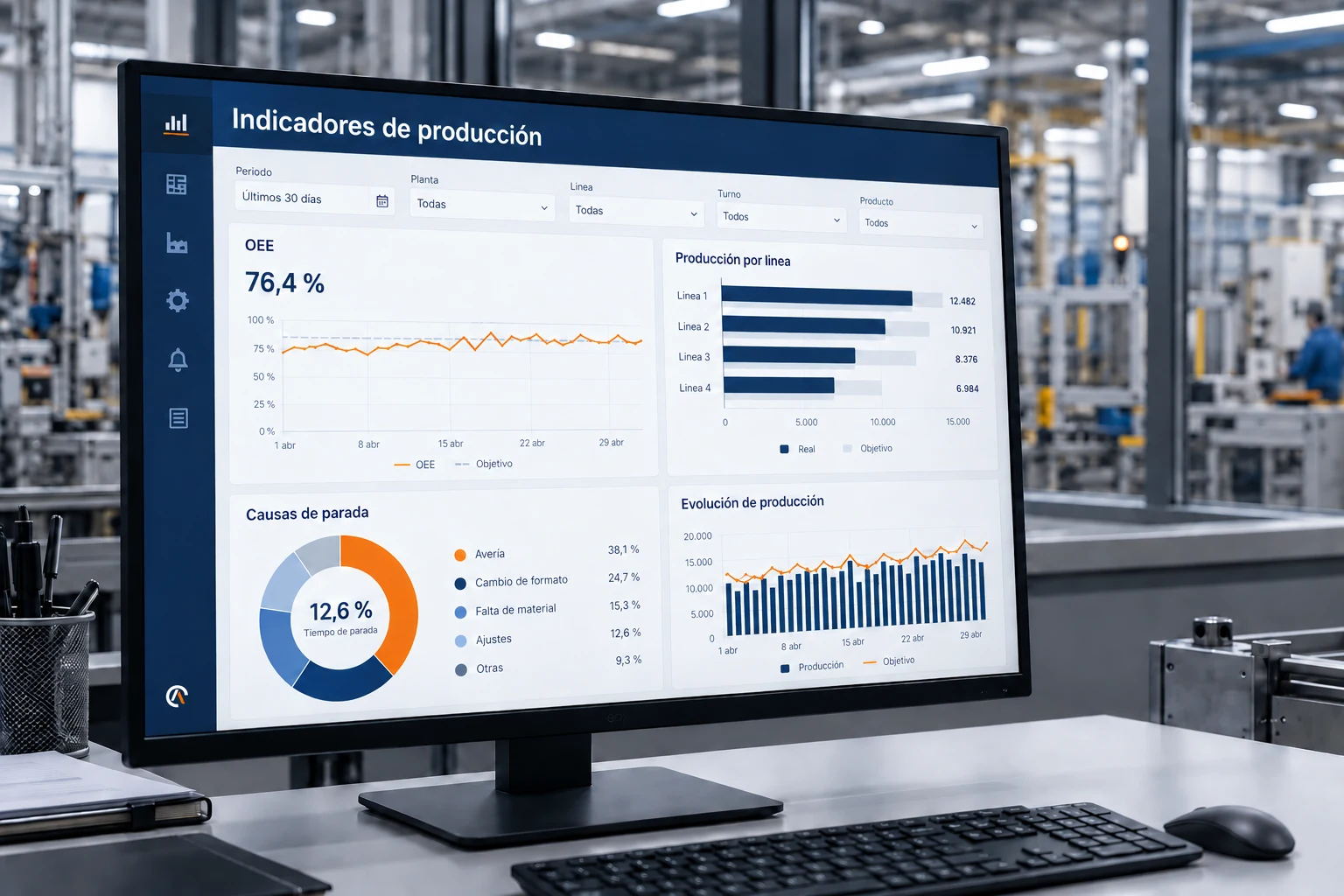
Connect information from your systems to understand what is happening and focus on the indicators each manager needs.
Engineering and software connected to your operation.
Reviews begin by gathering and reconciling spreadsheets and reports.
Each department calculates differently, making results difficult to compare.
Figures are available, but it is unclear what needs attention.
Believe it or not, some people make decisions in their company or factory like flipping a coin or shooting a dart at a target. These companies end up doing badly, sooner rather than later. Those that succeed and grow know that the best way to make decisions is to make use of the business intelligence, a set of tools integrated in big data, even able to make projections into the future.
The Industrial Business Intelligence is a software platform specifically for industrial companies, which integrates big data with artificial intelligence in real production processes, to build an efficient business intelligence system, which maps out the right strategies for the industry. There is no coin or dart capable of achieving such a thing. CAPTIA was awarded the National Technology Award for its Industrial Business Intelligence solutions.
At CAPTIA we are specialists in creating software specifically adapted to your needs, in order to increase the productivity of your factory. That's why we know that having a industrial consultant of business intelligence is absolutely essential.
The first thing that a business intelligence (BI) consultant will do is to know your production process. When configuring the software BI, the different profiles of the factory are taken into account. For example, the information that the product manager needs to see may be different from what the warehouse manager needs to see.. All this information comes from the same source (the data collected), but it lands by providing the details that each operator or manager needs to know to facilitate decision-making, immediate or long-term.
By combining big data and business intelligence, inefficient tasks are easier to detect, thus increasing your productivity.
By receiving real-time metrics and reports, it is easier to build a business plan and therefore increase profitability margin forecasting.
Workflow decisions, whether immediate or long-term, are crucial to avoid the dreaded bottlenecks that can lead to downtime.
Each operator or executive can have a personalised interface to receive the dedicated data he or she needs at any given moment.
It facilitates the integration of the different KPIs (key performance indicators) and provides a better understanding of the status of the different processes.
By systematising the combination of data analysis with processes, business intelligence tools are ready to handle future operations.
Questions and indicators should support the work of the person consulting them.
Review the data available in your systems.
Shared calculation criteria and definitions.
Information tailored to each decision.
View trends and deviations.
Schedule production by combining all factory data, from inventory input data to employee holiday periods.
Evaluate supplier performance to better negotiate prices, ensure timely deliveries and maintain high quality standards.
Create accurate financial and profitability models by analysing information provided by different departments in the factory.
Avoid production stoppages by anticipating unforeseen material shortages and replenishing according to actual demand at the workstation.
Which decisions you need to make.
Availability, quality and updates.
Criteria and visualisation.
Interpretation and usefulness of the information.
Data capture is done in real time. For this reason, it is necessary to MES system to support the massive data input constantly.
The data is filtered and structured in a past, present and future oriented approach with the support of the big data.
This huge volume of data is stored on one or more servers, distributed on replicated nodes to ensure security in case of failures.
Information is dynamically displayed through customised reports, dashboards and scorecards for each profile.
Not necessarily. We first review existing sources and the indicators you need. If reliable data is missing, the proposal must address how to obtain it.
Frequency depends on the sources, their connectivity and operational needs. It is defined in the project scope.
We include training for shop-floor staff unless it is determined to be unnecessary. If you need additional training, we can arrange it around your team’s needs.
We offer a priority support and maintenance service when you need it. We agree the service model, scope and terms with you to suit your operation.
We currently work in Spain. We can also undertake projects in Portugal, other European Union countries and beyond, agreeing the scope and working arrangements with you.
Connect information from your systems to understand what is happening and focus on the indicators each manager needs.
Tell us where you are starting. Together we will define the next step.