Reports arrive at the end of the shift
Actual manufacturing progress becomes visible after deviations occur.
Connect orders, operations and shop floor data to know what is being manufactured, how it is progressing and where you need to act.
Engineering and software connected to your operation.
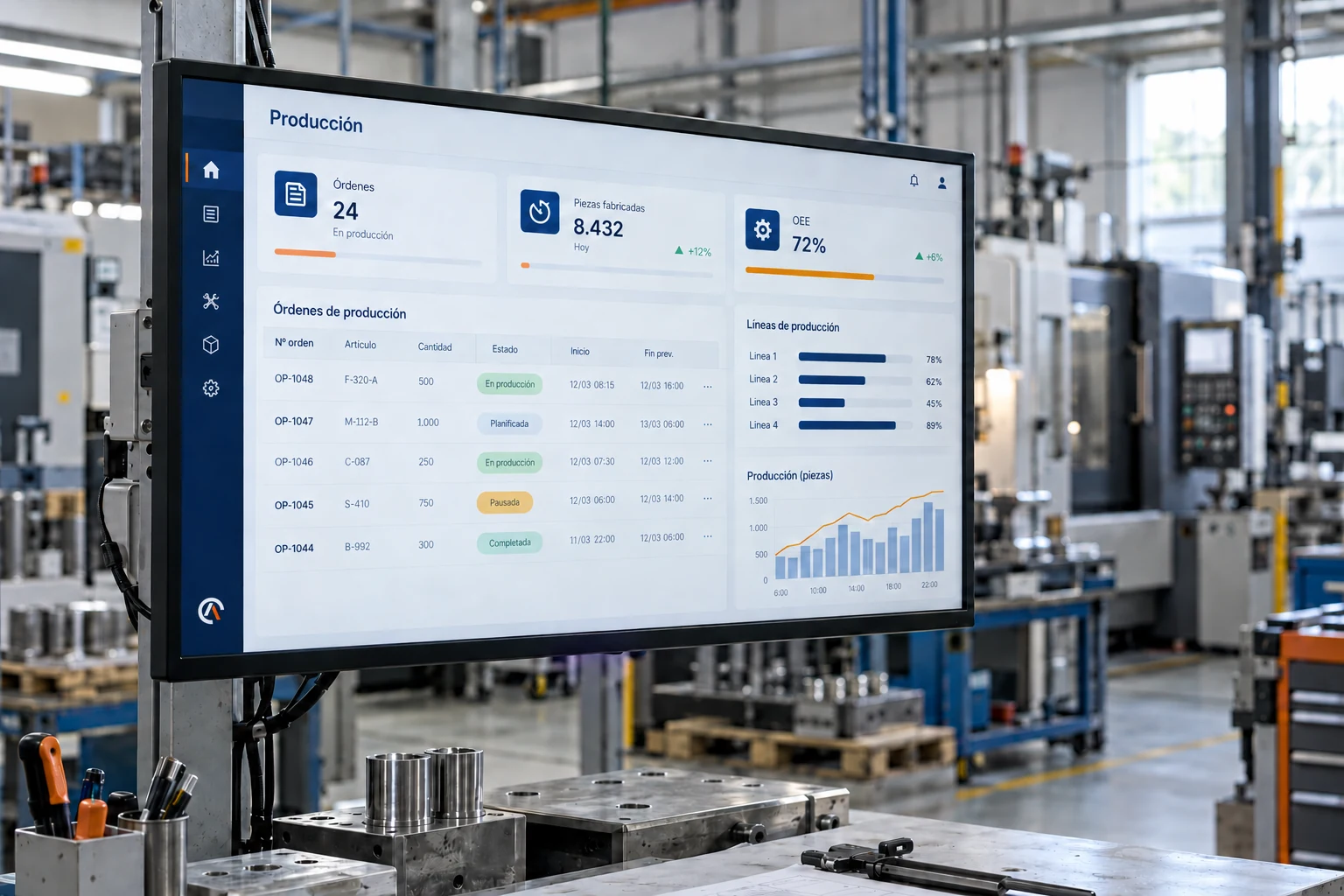
Actual manufacturing progress becomes visible after deviations occur.
Production, quality and planning use information that is difficult to connect.
You know something happened, but reconstructing the order, material and process means searching several sources.
Without any doubt, top factories have a MES system (Manufacturing Execution System) integrated that controls their production. This control is executed through the real-time analysis and documentation of the elements of the production process (raw materials, operators, equipment, etc.) from the beginning until the final product is obtained.
The MES system also determines the degree of efficiency and productivity of the entire industrial process, including the upstream phase of raw material procurement and warehouse systems management, the downstream phase of dependence on third-party services and the downstream phase of distribution and logistics.
Imagine a rope like those used by mountain climbers. If you look closely at that rope, you will see that it is made up of dozens of fine ropes braided together harmoniously. Just one of them would be unable to support your weight, but all of them together, perfectly intertwined, give rise to the rope that will take you to the summit of your mountain.
That is the MES system: the seamless integration of all work processes and functions of your production system. This includes managing resources, preparing and dispatching orders, collecting data on overall team effectiveness, and more. Our MES system goes beyond software: it is an end-to-end solution that includes software, process analytics, artificial intelligence, data analysis and storage, and even equipment refurbishment, if necessary.
Determining the efficiency of the industrial process is mandatory to be able to detect and correct faults in the supply chain.
Manage the precise intervention of raw materials, inventory, operators, equipment and external services to set your priorities.
Generates productivity reports for operational decision making, external audits, opportunity detection, etc.
Coordinate the different departments of your factory (both operational and management) to control the flow of your production according to your needs.
By standardising processes through an MES system, you can replicate your production model if you open another plant.
By documenting your entire factory process in real time, you can provide evidence of action in case of external conflicts related to your product.
A production view should help you locate work in progress and reach the detail of each operation.
Orders and operations connected to shop floor activity.
Connections between materials, products and processes.
Explore this capability ↗Work instructions alongside the operation.
Explore this capability ↗Check results within the manufacturing workflow.
Explore this capability ↗Link data from devices directly to the system without human intervention.
Implement permanent quality controls at any stage of the production process.
Eliminate bottlenecks in your processes in advance through data analysis.
Automatically adjust the stock of raw materials to cover production within the deadlines you decide.
The first thing is to know your factory: what processes it runs, what data is taken, which areas can be digitised, etc.
Which line, operation or problem to address first.
We integrated the data we received to prototype the first software models of the MES system.
We coordinate the software with the Enterprise Resource Planning (ERP) system and the product traceability.
We implemented it in a test phase to further collect data with different inputs.
We monitor the results and extend the software until all processes are integrated into the MES system.
We start by studying the relationship between the ERP and shop-floor execution. We define which information each system should exchange and which integrations are needed.
We can assess a limited initial scope and identify its dependencies before expanding it. The specific proposal depends on the process.
A description of the process, existing systems and difficulties you want to resolve. We then agree which data and people need to be involved.
We include training for shop-floor staff unless it is determined to be unnecessary. If you need additional training, we can arrange it around your team’s needs.
We offer a priority support and maintenance service when you need it. We agree the service model, scope and terms with you to suit your operation.
We currently work in Spain. We can also undertake projects in Portugal, other European Union countries and beyond, agreeing the scope and working arrangements with you.
Connect orders, operations and shop floor data to know what is being manufactured, how it is progressing and where you need to act.
Tell us where you are starting. Together we will define the next step.